How We Detect Hiring Signals in 225K+ Job Postings Daily
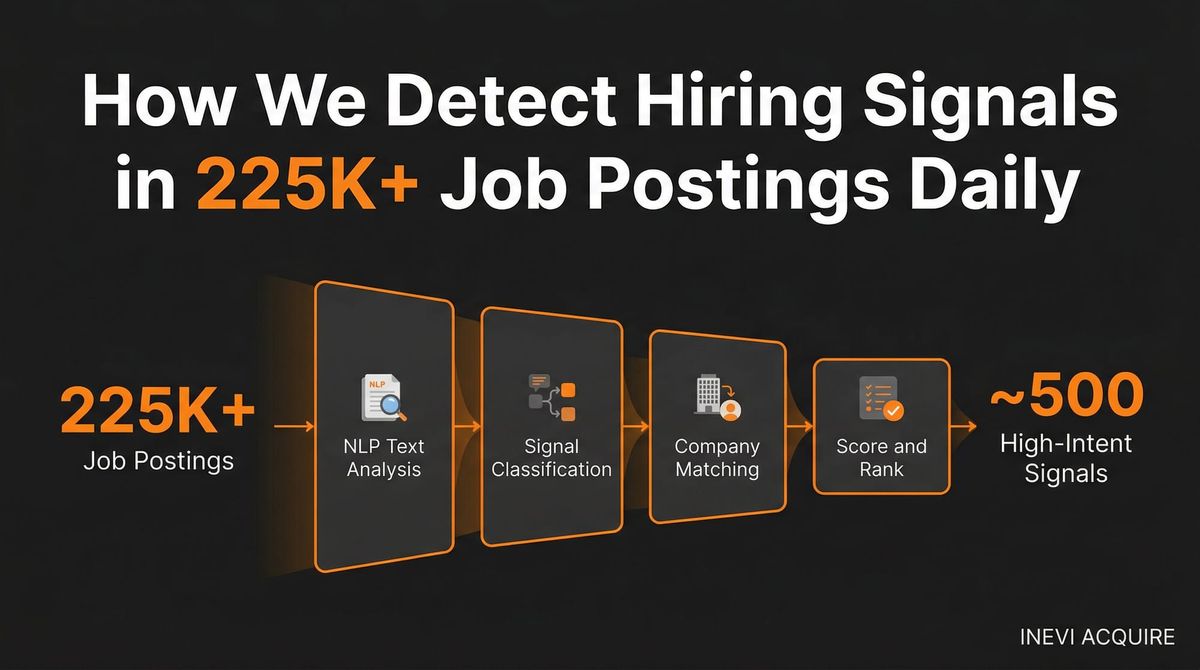
We monitor 225K+ job postings daily using full description text analysis, not just title filters. Here's how hiring signal detection works and why it outperforms funding signals.
How We Detect Hiring Signals in 225K+ Job Postings Daily
Most people in B2B sales think funding rounds are the best buying signal. They're wrong.
Hiring signals are 3x more predictive of near-term buying intent than funding signals. Here's why: a funding round means a company has money. A hiring signal means they're actively trying to spend it on the exact problem you solve.
I've spent the last six months building and refining the hiring signal detection layer of our outbound system. This post walks through exactly how it works — the architecture, the edge cases, and the data that convinced us to make hiring signals our highest-weighted signal type.
Why Hiring Signals Beat Funding Signals
Hiring signals are job postings or staffing changes that indicate a company is actively investing in a capability relevant to what you sell. When a company posts a job for an "AI Implementation Specialist" in their sales department, they've already decided they need AI in their sales process. They have budget allocated. They're actively looking for a solution.
The gap between "looking for a person to solve this problem" and "would consider a service that solves this problem" is tiny. That's what makes hiring signals so powerful.
Funding signals, by contrast, indicate capital availability — not intent. A company that raised a Series B has money, but they might spend it on engineering, marketing, customer success, or 15 other priorities before they get to outbound. The signal is real but the timing is loose.
The Data
From six months of running both signal types side by side on the same target accounts:
| Metric | Funding Signals | Hiring Signals |
|---|---|---|
| Reply rate | 4.2% | 11.7% |
| Positive reply rate | 1.8% | 5.3% |
| Meeting conversion | 0.9% | 2.8% |
| Average days from signal to reply | 12 | 6 |
| Signal-to-meeting ratio | 1 in 111 | 1 in 36 |
Hiring signals convert at roughly 3x the rate of funding signals for us. The faster response time (6 days vs 12 days) makes sense — a company actively hiring for a capability has more urgency than one that just got funded.
This doesn't mean funding signals are useless. They're valuable as a compound signal — a company that raised AND is hiring is the strongest combination. But if you're only tracking one signal type, hiring beats funding.
The Title-Based Filter Problem
Most tools that track hiring signals use title-based filters. You set up a search for "GTM Engineer" or "AI Sales Engineer" and the tool returns matching job postings.
Title-based filters miss 60% of real hiring signals. Here's why.
Titles are inconsistent. The same role gets posted under dozens of different titles. "AI Implementation Specialist," "Sales Automation Manager," "Revenue Operations Engineer," "Growth Hacker" — these can all describe the same hire. A title filter catches the exact titles you specified and misses every variation.
Intent lives in the description, not the title. A posting titled "Sales Operations Manager" might have a description that says "evaluate and implement AI-powered outbound tools, build automated prospecting workflows, and connect our CRM to signal detection platforms." That description is a direct buying signal for what we sell. But a title filter for "AI" or "GTM" would miss it entirely.
Generic titles hide specific intent. "Marketing Manager" could be a content marketing role, a demand gen role, or a role focused on building outbound infrastructure. The title tells you nothing. The description tells you everything.
Our Approach: Full Description Text Analysis
Instead of filtering by title, we analyze the full text of every job posting. The system processes 225,000+ postings daily across major job boards and company career pages.
Here's the workflow at a high level:
Step 1: Ingestion. The system pulls new and updated job postings from multiple sources. We don't rely on a single job board because each one has coverage gaps. LinkedIn, Indeed, Greenhouse, Lever, and company career pages each surface different listings.
Step 2: Text extraction. We pull the full description text, required qualifications, and responsibilities sections. This is where the signal lives.
Step 3: Signal matching. The system scans the description for patterns that indicate buying intent relevant to our clients' offerings. This isn't keyword matching — it's pattern recognition across clusters of related terms.
For example, a posting that mentions "evaluate outbound tools," "build automated prospecting," and "connect data sources" in the same description is a strong signal even if the title is "Sales Operations Manager." The co-occurrence of these concepts creates a signal that no individual keyword would trigger.
Step 4: Scoring. Each matched posting gets a signal strength score based on: - How specific the intent language is (vague "improve sales" vs. specific "implement signal-based prospecting") - The seniority of the role (VP posting = more budget authority than coordinator) - The department (sales/revenue ops = direct relevance, engineering = indirect) - How recently the posting went live (fresher = more urgent)
Step 5: Company qualification. The posting is mapped to the company, and the company is checked against the client's ICP criteria. A perfect hiring signal at a B2C consumer brand with 5 employees is noise, not a lead.
Edge Cases That Break Simple Implementations
Building the hiring signal layer taught us things that aren't in any product documentation. Here are the edge cases that matter.
The Replacement vs. Expansion Problem
When a company posts a job, it could be replacing a departure or expanding the team. The difference matters. Replacement hires indicate existing capability — the company already does this and needs to keep doing it. Expansion hires indicate new capability — the company is building something it doesn't have yet.
For outbound purposes, expansion hires are a stronger signal. A company building a new AI-powered outbound function is a better prospect than one replacing an existing sales ops manager.
How we distinguish: we check whether the company previously had someone in that role (via organizational data) and whether the posting language emphasizes "building from scratch" or "managing existing" processes.
The Reposted Job Problem
Job boards are full of reposted listings. A company posts a role, gets no qualified applicants, and reposts it 30 days later. Without deduplication, the system would detect this as two separate signals and potentially trigger two outreach sequences.
We fingerprint each posting based on company + role description hash and track repost frequency. A repost is actually a stronger signal than the original posting — the company has been trying to hire for this capability and can't find the right person. They might be more receptive to a service that solves the problem without the hire.
The Agency Hiring Problem
Some job postings that look like company hires are actually recruiting agencies posting on behalf of clients. The signal is still valid, but the company name in the posting might be the agency, not the end client.
We cross-reference the posting entity against known agency databases and company size data. If a 12-person company posts 40 engineering roles in a week, they're a recruiting agency — not a scaling startup.
The Ghost Posting Problem
Some companies post jobs they never intend to fill — to collect resumes, to signal growth to investors, or to meet internal compliance requirements. Ghost postings generate noise in the signal data.
We track posting-to-hire conversion by company over time. Companies with a high ratio of postings to actual hires get a reduced signal weight.
Putting It Together: From Signal to Outreach
Here's what the full flow looks like when the hiring signal detection layer catches a relevant posting.
- Signal fires: A B2B SaaS company with 45 employees posts a job for "Revenue Operations Lead" with description text mentioning "evaluate and implement AI-powered prospecting tools" and "build outbound infrastructure from scratch."
- Score: 8.5/10. Specific intent language. VP-level role. Sales department. Fresh posting (2 days old). Expansion hire (no previous RevOps function).
- Company qualifies: $4M ARR, Series A (funded 8 months ago), B2B SaaS, 45 employees, no existing outbound system. Matches ICP criteria.
- Enrichment: System identifies the CEO and VP Sales as decision-makers. Enriches contact data from three sources. Verifies email addresses through two methods. Bounce prediction: <0.5%.
- Sequence triggered: First email to the CEO references the job posting: "I noticed you're hiring a Rev Ops Lead to build outbound infrastructure from scratch. Before you spend 3 months hiring and 3 months ramping, I wanted to show you what a working system looks like."
- Reply received, day 3: "Interesting timing. We've had the role open for 6 weeks with zero qualified applicants. Can you tell me more?"
This is signal-based outbound. The email went out because something real happened. The timing was right. The message was relevant. And the reply came because the prospect recognized their own situation in the outreach.
What This Means for Your Outbound
If you're building or buying outbound, here are the takeaways:
Track hiring signals, not just funding. Funding means capital. Hiring means intent. Intent converts 3x better.
Don't rely on title-based filters. They miss more than half of real signals. Full description analysis catches the intent that titles obscure.
Treat hiring signals as time-sensitive. The best window is 2-14 days after a posting goes live. After that, the company may have already started interviewing candidates or found another solution.
Combine signals. Hiring + funding + tech adoption together is the strongest combination. A company that raised a round, started hiring for outbound infrastructure, and adopted a new CRM is telling you exactly what they're building.
The companies that figure out signal detection first are booking meetings while everyone else is still buying lists.
FAQ
What is a hiring signal in B2B sales?
A hiring signal is a job posting or staffing change that indicates a company is actively investing in a capability relevant to what you sell. For outbound sales, the most valuable hiring signals are roles related to revenue operations, sales automation, AI implementation, and outbound infrastructure. These signals indicate budget allocation and active intent.
Why do hiring signals outperform funding signals?
Funding signals indicate a company has capital to spend, but not what they'll spend it on. Hiring signals indicate specific intent — the company is actively trying to hire someone to do the exact thing your product or service does. Our data shows hiring signals convert to meetings at 3x the rate of funding signals.
How many job postings do you monitor?
Our system processes 225,000+ new and updated job postings daily across multiple job boards and company career pages. We use full description text analysis rather than title-based filters, which catches 60% more relevant signals than title-only approaches.
Can I detect hiring signals with Clay?
Clay can integrate with job posting data sources, but the signal detection quality depends entirely on how you build the workflow. Title-based matching in Clay will miss the majority of signals. Building full-text analysis, deduplication, ghost posting detection, and replacement-vs-expansion classification requires significant workflow engineering on top of what Clay provides out of the box.
How quickly should I act on a hiring signal?
The optimal window is 2-14 days after a job posting goes live. Within this window, the company is still defining their approach and is most open to alternatives. After 30 days, they've likely progressed in interviewing candidates and are less receptive to a service-based alternative. Reposted listings (30+ days with no hire) can actually be stronger signals — the company has been trying and failing to find the right person.
Want to see which hiring signals your ideal customers are sending right now? Get a free Signal Audit — no commitment, no card required.