Why We Don't Guarantee Meetings (And Why That's Better for You)
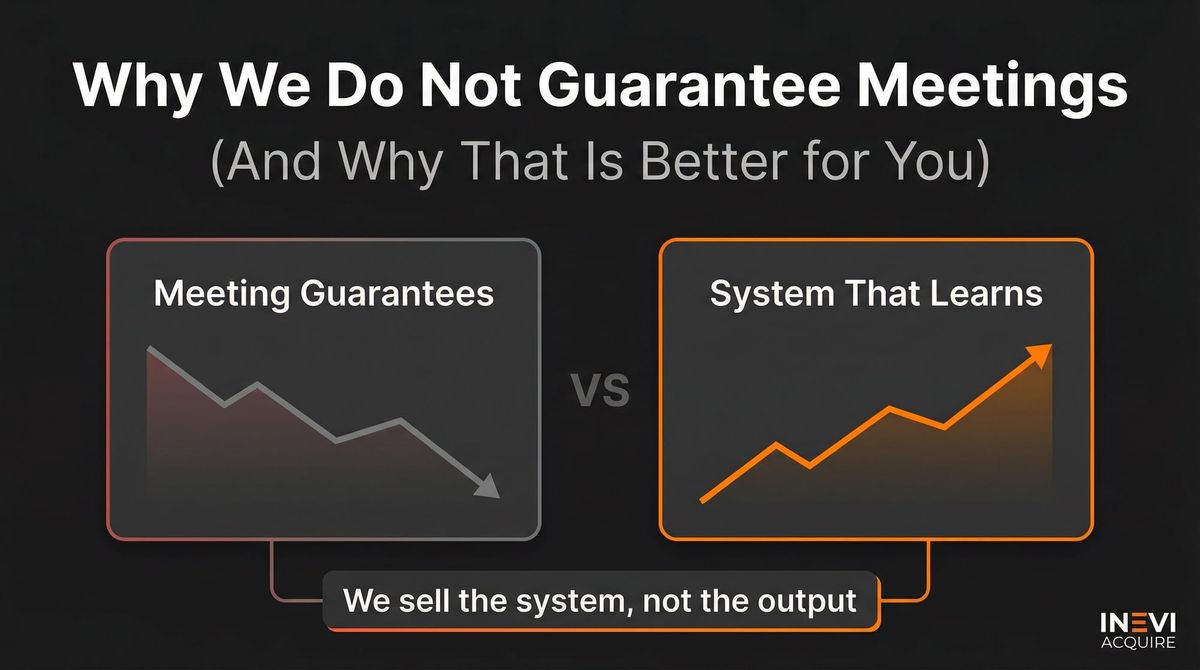
Meeting guarantees in outbound incentivize gaming quality. We sell the system, not the output. Here's why that difference matters for your pipeline.
Why We Don't Guarantee Meetings (And Why That's Better for You)
Every outbound agency you talk to will offer a meeting guarantee. "20-30 qualified meetings per month." "Guaranteed pipeline." "Risk-free trial with meeting commitments."
We don't do this.
Not because we can't book meetings. We can. The system works. But guaranteeing a meeting number creates a set of incentives that damages the exact thing you're paying for: qualified pipeline that converts to revenue.
Here's why meeting guarantees are a red flag, not a selling point.
What a Meeting Guarantee Actually Incentivizes
A meeting guarantee in outbound means an agency commits to delivering a specific number of meetings per month, typically 20-30. If they miss the number, the client gets a discount, additional months free, or can cancel. It sounds like the agency is putting skin in the game. In reality, it warps every decision they make.
When an agency's contract depends on hitting a meeting number, here's what happens downstream:
The Qualification Bar Drops
20 meetings sounds great. But "meeting" is a flexible term. Is it a meeting with a qualified decision-maker who has budget and intent? Or is it 30 minutes with a junior employee who took the call because they were curious?
When the number matters more than the quality, the qualification bar quietly drops. The agency broadens the target list to include companies that technically match the ICP but have no real buying intent. They accept meetings from people who aren't decision-makers. They count "discovery calls" as "qualified meetings" even when the prospect was just being polite.
Your sales team ends up in 25 meetings a month. 8-10 of them go nowhere. That's 8-10 hours of selling time wasted on conversations that were never going to convert — plus the follow-up emails, CRM updates, and internal discussions about dead-end leads.
The math looks like this:
| Metric | With Guarantee | Without Guarantee |
|---|---|---|
| Meetings delivered/month | 25 | 12 |
| Actually qualified | 15 (60%) | 10 (83%) |
| Converted to opportunity | 5 (20%) | 5 (42%) |
| Sales hours on unqualified | 10 hours | 2 hours |
| Cost per qualified meeting | Higher (sales time wasted) | Lower (higher hit rate) |
Same number of opportunities. Different cost in sales time and morale. The guarantee delivered 25 meetings. It didn't deliver more revenue.
The Messaging Gets Aggressive
When the number is the goal, messaging drifts from relevant to aggressive. The agency needs more replies, so the emails get pushier. More urgency plays. More "I noticed you looked at our website" triggers that may or may not be true. More "just following up for the 4th time" sequences that annoy prospects.
This damages your brand in ways that don't show up in the agency's weekly report. Prospects who receive aggressive outreach don't just ignore it — they remember who sent it. When your sales team reaches out to those same companies through a different channel six months later, the door is already closed.
Long-Term Thinking Disappears
Meeting guarantees are inherently short-term. "What do I need to do this month to hit the number?" replaces "How do I build a system that produces better results over time?"
Feedback loops — analyzing which signals predict meetings, which messaging converts, which data sources are most accurate — require investment that doesn't pay off immediately. An agency under meeting pressure doesn't invest in long-term optimization. They invest in this month's number.
This is why agency results almost always degrade after 90 days. The easy targets get contacted first. Without a system that continuously improves and surfaces new opportunities, the agency runs out of quality prospects faster than it can find new ones.
What We Sell Instead
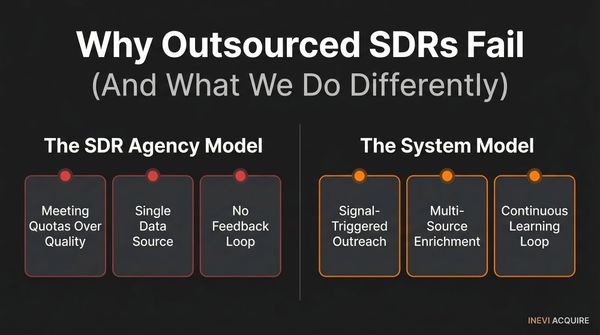
We sell the system. The infrastructure, the operation, and the expertise to run it.
This isn't a semantic distinction. It changes the fundamental incentive structure.
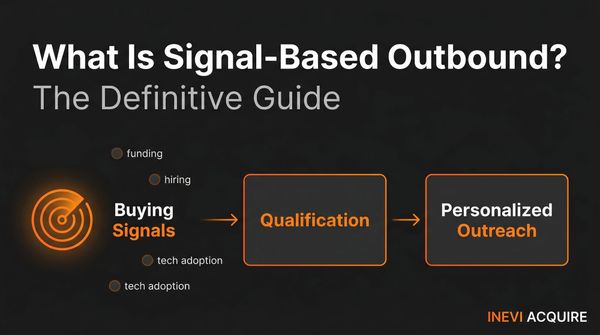
When we sell the system, our success metric is: is the system working correctly? A correctly calibrated system detects real buying signals, qualifies companies against your ICP, enriches contacts from multiple sources, verifies every email address, and sends personalized outreach with the right message at the right time.
A working system produces qualified meetings as a natural output. But the meetings are the output, not the product. The product is the engine.
What This Means in Practice
We optimize for system health, not meeting volume. If reply rates drop, we diagnose the system — is a signal source degrading? Is a data provider returning bad emails? Has the messaging gone stale? We fix the root cause instead of sending more emails to worse targets.
We tell you when the system is underperforming. An agency with a guarantee is incentivized to hide problems until the client notices. We're incentivized to surface issues early because the system's health is what we're selling.
We don't inflate numbers. Every meeting that comes through the system was triggered by a real signal. The company showed buying intent. The decision-maker was verified. The email was relevant. We don't pad the numbers with marginal contacts because we don't need to hit a number to keep the contract.
How to Evaluate Without Guarantees
If we're not guaranteeing meetings, how do you evaluate whether the system is working? Fair question. Here's the framework:
Leading Indicators (Weeks 1-4)
Before meetings happen, these signals tell you the system is running correctly:
- Deliverability rate: 95%+ inbox placement (emails are reaching the inbox, not spam)
- Bounce rate: Under 2% (data quality is high, verification is working)
- Signal detection volume: Signals are being detected for companies that match your ICP
- Sequence activation rate: Qualified prospects are entering outreach sequences
- Open rate: 40%+ (subject lines are working, inbox placement is good)
Core Metrics (Months 1-3)
Once the system is running at scale:
- Reply rate by signal type: Which signals produce the most engaged responses
- Positive reply rate: What percentage of replies are interested (not "unsubscribe me")
- Meeting quality score: Are meetings converting to opportunities at your historical close rate or better?
- Cost per qualified meeting: All-in cost divided by meetings that your sales team rates as qualified
Compounding Indicators (Months 3+)
The test of a system vs. a campaign — is it getting better over time?
- Month-over-month reply rate trend: Should be stable or improving
- Signal-to-meeting conversion trend: Should improve as the system learns which signals predict intent for your market
- Meeting quality trend: Should improve as qualification gets tighter based on conversion data
The Question to Ask Every Vendor
When an outbound vendor offers a meeting guarantee, ask one question:
"If you book 25 meetings this month and only 3 are qualified, have you fulfilled the guarantee?"
If the answer is "yes, technically" — you've learned everything you need to know about what the guarantee actually protects. It protects the vendor's revenue, not your pipeline.
The right question isn't "how many meetings will you deliver?" It's "what system are you building to generate qualified pipeline, and how does it improve over time?"
A system that books 12 qualified meetings per month — 10 of which convert to opportunities — is worth infinitely more than a guarantee of 25 meetings where 8 are dead ends.
We'd rather give you 12 real conversations than 25 calendar fillers.
FAQ
Why do outbound agencies offer meeting guarantees?
Meeting guarantees are primarily a sales tool, not a quality assurance mechanism. They reduce perceived risk for the buyer and make the agency's service easier to sell. The problem is structural: when the contract depends on hitting a number, every downstream decision optimizes for volume over quality. This leads to expanded target lists, lowered qualification bars, and aggressive messaging that damages the client's brand.
What happens if Inevi Acquire doesn't book meetings?
We share full system performance data — signal detection rates, deliverability metrics, reply rates, meeting quality — so you can see exactly where the system is performing and where it needs calibration.
How do I know the system is working if there's no guarantee?
Track leading indicators in weeks 1-4 (deliverability rate above 95%, bounce rate under 2%, signals being detected for ICP-matching companies) and core metrics in months 1-3 (reply rate by signal type, positive reply rate, meeting quality scores). A working system shows compounding improvement — month 3 should be measurably better than month 1.
Is a meeting guarantee ever appropriate?
Meeting guarantees can work for high-volume, low-consideration sales where any meeting has roughly equal value — like scheduling demos for a self-serve software product where the close process is standardized. They're destructive for considered purchases, complex sales, or situations where meeting quality matters more than meeting volume.
Want to see what signal-based outbound looks like for your market? Get a free Signal Audit — no commitment, no card required.