Why Outsourced SDRs Fail (And What We Do Differently)
Outsourced SDR teams fail because they sell meeting quotas, use single data sources, and have no feedback loops. Here's the structural problem and the alternative.
Why Outsourced SDRs Fail (And What We Do Differently)
I've talked to dozens of B2B founders and VPs of Sales in the last three months. Almost half of them have the same story: they hired an outsourced SDR agency, it worked for 60-90 days, then the results fell off a cliff. Now they're back to doing outbound themselves — or not doing it at all.
The outsourced SDR model isn't broken because of bad people. It's broken because of structural incentives. The way most SDR agencies get paid, the way they source data, and the way they operate day-to-day makes long-term success nearly impossible.
Here's what goes wrong and why.
The Structural Problem: Selling Meetings
Most outsourced SDR agencies sell meeting quotas. "We'll deliver 20-30 qualified meetings per month." It sounds great in the sales pitch. The problem is what it incentivizes.
When an agency's revenue depends on hitting a meeting number, every decision gets filtered through "does this help us hit the number?" That question creates three predictable failures:
Failure 1: Quality Erosion
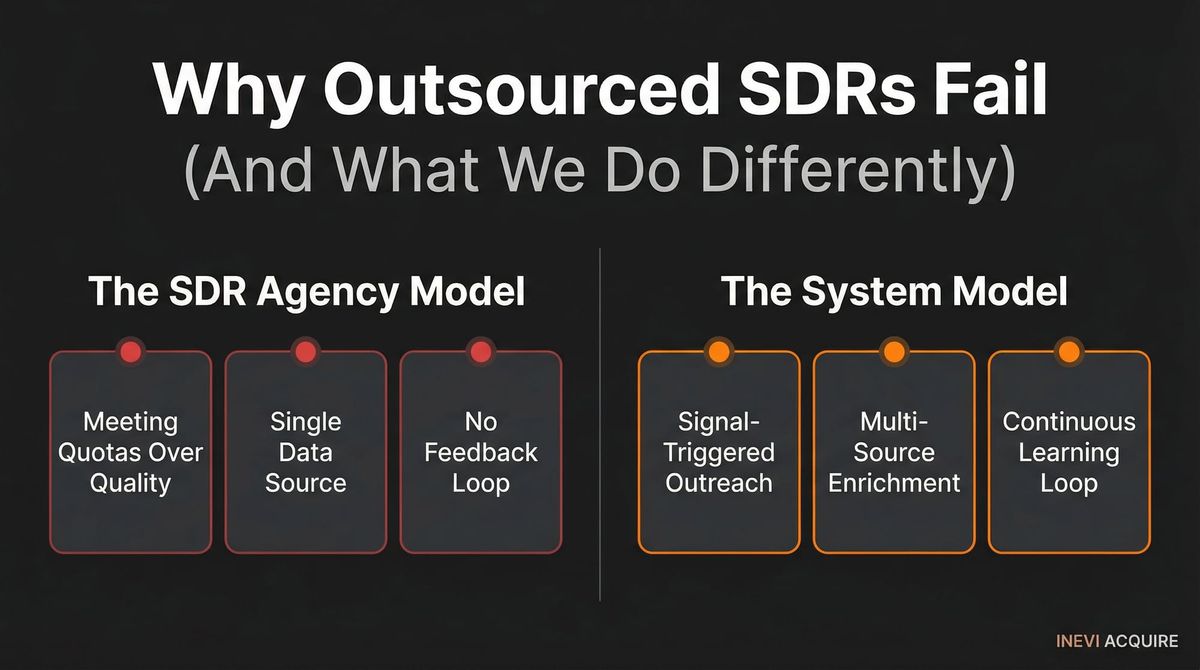
Outsourced SDR agencies often fail because their business model — selling meeting quotas — incentivizes booking meetings with anyone who will take a call, not just qualified prospects. This structural misalignment leads to quality erosion, wasted sales time, and client churn within 3-6 months.
The easiest way to hit a meeting quota is to lower the qualification bar. Expand the target list. Accept meetings from companies that are technically in the ICP but have no real buying intent. Count "discovery calls" as "qualified meetings" even when the prospect was just being polite.
Your sales team shows up to 25 meetings a month. 8 of them are with companies that will never buy. That's 8 hours of wasted selling time plus the follow-up, CRM notes, and internal discussions about leads that were dead on arrival.
The worst part: you don't realize this is happening until month two or three, when your close rate from outsourced meetings drops to a fraction of your close rate from inbound or referral meetings.
Failure 2: The 90-Day Cliff
Outsourced SDR results almost always degrade after the first quarter. The pattern is remarkably consistent across agencies:
Month 1: Strong results. The agency built an initial list of companies that closely match the ICP. The messaging is fresh. The sending domains are clean. Reply rates are decent.
Month 2: Results hold but start slipping. The highest-quality prospects from the initial list have been contacted. The agency pulls the next batch — still okay, but slightly less targeted.
Month 3: Results noticeably decline. The easy targets are exhausted. The agency starts reaching further down the list. Messaging hasn't evolved because nobody's analyzing what worked and what didn't. The sending domains may have deliverability issues from three months of sending.
Month 4-6: The client starts asking questions. "Why are these meetings worse than the first month?" The agency blames market conditions, timing, or "your ICP is too narrow." The real answer: their operating model doesn't include feedback loops, multi-source data, or signal-based targeting. They ran out of good list.
A 2025 industry analysis found that 68% of companies that left outsourced SDR agencies cited "declining meeting quality" as the primary reason, ahead of cost, communication, or service issues.
Failure 3: No Feedback Loops
The third structural failure is the most damaging: outsourced SDR agencies almost never build feedback loops.
A feedback loop means the system learns from its results. Which messaging angles drive replies? Which signal types predict meetings? Which companies converted to opportunities vs. which were dead ends? Which data sources provided the most accurate contact information?
Most SDR agencies operate on a "send and report" model. They send sequences, track opens and replies, and report the numbers weekly. But they don't analyze why certain messages worked, they don't adjust targeting based on conversion data, and they don't improve the system for next month based on this month's results.
Without feedback loops, the system doesn't compound. Month 6 looks like month 1 — or worse, because the easy targets are gone and nothing was learned from the first five months of data.
The Data Problem
Beyond the incentive misalignment, most SDR agencies have a data problem that makes long-term success structurally unlikely.
Single-Source Data
The typical outsourced SDR pulls contact data from one provider — usually Apollo, ZoomInfo, or a similar platform. One source means one set of coverage gaps, one set of inaccuracies, and one set of stale contacts.
No single data provider covers more than 70-75% of any given market segment. We've tested this extensively. When we ran the same list of 500 target companies through three different enrichment providers, no single provider returned valid contact data for more than 74% of them. By cross-referencing three providers, we got to 91%.
An SDR agency using one source is missing 25-30% of their addressable market before they write a single email.
List-Based, Not Signal-Based
SDR agencies buy lists. They filter by firmographics — industry, company size, location, revenue range — and pull everyone who matches. The list doesn't tell them when a company is ready to buy. It just tells them the company exists and matches some criteria.
This is like cold-calling the phone book vs. calling someone who just searched for your product. The timing difference is everything.
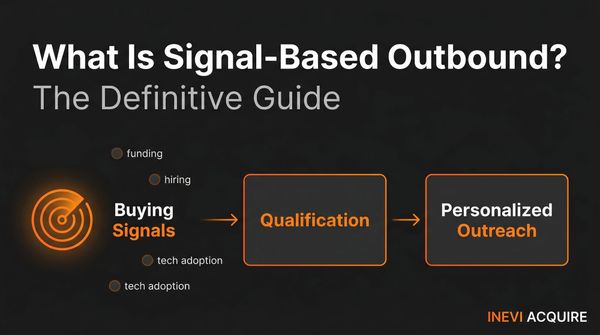
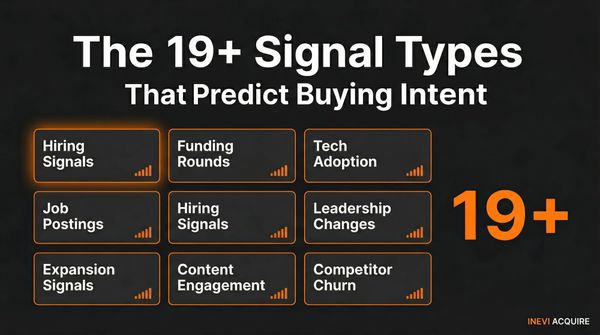
Signal-based targeting detects real events — funding rounds, hiring signals, technology changes, competitive moves — and triggers outreach when the timing is right. An SDR agency that sends the same sequence to a static list every month has no timing advantage. They're hoping for coincidence.
No Verification Layer
Bounce rates above 3% damage sender reputation and trigger spam filters. Most SDR agencies do basic email verification, but basic verification catches obvious invalid addresses (syntax errors, non-existent domains) while missing the subtler problems: catch-all domains that accept everything but deliver nothing, role-based addresses that never reach a person, and recently churned email addresses that haven't been removed from databases yet.
We verify every email through two independent methods and achieve bounce rates under 2%. The difference between 2% and 5% bounce rate compounds over thousands of emails sent monthly — it's the difference between 95%+ inbox placement and gradually burning your sending domains.
What "Doing It Differently" Actually Means
Saying "we're different from agencies" is easy. Every new vendor says it. Here's what's structurally different about a managed system approach vs. the outsourced SDR model.
We Sell the System, Not the Output
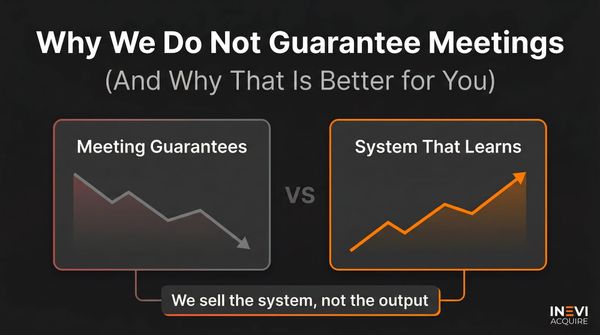
We don't sell meeting quotas. We sell the system — the infrastructure, the operation, and the expertise to run it. This isn't a semantic distinction. It changes every downstream incentive.
When you sell meetings, you optimize for volume. When you sell the system, you optimize for the system working correctly. A system that works correctly produces qualified meetings as a natural output. But "qualified" isn't a number we need to inflate to keep the contract — it's a measure of whether the system is calibrated properly.
If the system isn't producing meetings, that's a calibration problem. We fix the system. We don't send more emails to worse targets to hit a number.
Multi-Source Data, Not Single-Source
We cross-reference signals and contacts across 6+ data providers. This gives us 20-25% more coverage than any single-source approach and significantly better data accuracy. When three providers agree on a contact's email address, our confidence is high. When they disagree, we investigate before sending.
Signal-Based Targeting, Not List-Based
Every outreach is triggered by a real event. A company raising funding. Posting a relevant job listing. Adopting new technology. Showing buying signals that indicate the timing is right.
This means we don't exhaust a list after 90 days. The system continuously detects new signals across the market. Companies that weren't relevant last month might show a buying signal this month. The addressable market refreshes itself.
Built-In Feedback Loops
The system learns from every response. Which signal types produce the highest reply rates for this specific client? Which messaging angles convert? Which data sources have the best accuracy for this market segment?
After 90 days, the system is measurably better than it was on day one. After six months, it's operating on a level of optimization that no outsourced SDR team can match — because the optimization is embedded in the system architecture, not dependent on an individual account manager's judgment.
How to Evaluate Your Current Setup
If you're currently using an outsourced SDR team, here are five questions to ask:
- What's your close rate from outsourced meetings vs. inbound/referral meetings? If outsourced meetings close at less than half the rate, the qualification bar is too low.
- Are results improving month-over-month, or declining? A system should compound. If month 4 is worse than month 1, there are no feedback loops.
- How many data sources does the agency use for contacts? If the answer is one, they're missing 25-30% of your addressable market.
- Is outreach triggered by events, or sent to a static list? List-based outreach has no timing advantage. Signal-based outreach reaches companies when they're most likely to engage.
- What happens if the system doesn't produce results in 60 days? If the answer involves the word "ramp" or "patience" without specific optimization plans, there's no feedback loop.
The point isn't to trash every SDR agency. Some companies genuinely just need meeting volume and have strong enough close rates to make the model work. But for most B2B companies — especially those selling considered purchases to mid-market buyers — the outsourced SDR model creates a ceiling that gets lower over time.
The alternative is infrastructure that compounds.
FAQ
Why do outsourced SDR results decline after 90 days?
Most SDR agencies exhaust their highest-quality prospects from the initial list in the first quarter. Without signal-based targeting that continuously surfaces new prospects as buying signals appear, they fall back on diminishing-quality contacts from the same static data source. The sequences that worked in month one stop performing because the audience quality dropped.
How much does an outsourced SDR team cost?
Typical outsourced SDR agencies charge $3,000-10,000/month with 3-6 month minimum contracts. In-house SDR hires cost $60,000-80,000/year in salary plus benefits, management overhead, and 3-month ramp time. A managed outbound system runs with no ramp period and is live in about two weeks.
What's the difference between an SDR agency and a managed outbound system?
An SDR agency sells meeting quotas from a static list. A managed system sells the infrastructure and expertise to detect buying signals, qualify companies, enrich contacts from multiple sources, and trigger outreach based on real events. The incentive structure, data approach, and feedback mechanisms are fundamentally different.
Can outsourced SDRs work for any company?
Outsourced SDRs can work for companies with proven product-market fit, strong close rates, and a need for meeting volume over meeting quality. They work less well for companies selling complex or considered purchases to mid-market buyers, where timing, relevance, and qualification matter more than volume.
What should I look for in an outbound partner?
Look for: multi-source data (not single provider), signal-based targeting (not static lists), built-in feedback loops (system improves monthly), and transparency into the process (dashboard, not PDF reports). Avoid: meeting guarantees (incentivizes gaming quality) and single-source data approaches.
Want to see what signal-based outbound looks like for your market? Get a free Signal Audit — no commitment, no card required.