What Is Signal-Based Outbound? The Definitive Guide
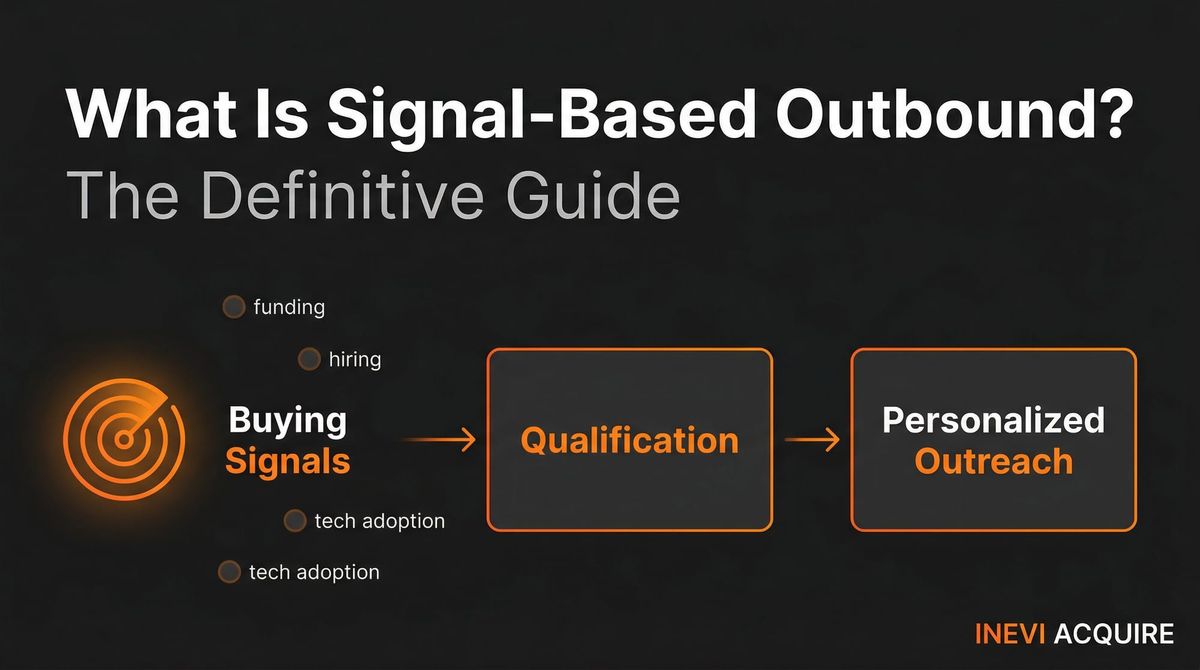
Signal-based outbound triggers every email based on real buying signals like funding, hiring, and tech adoption. Learn how it works and why it outperforms list-based outbound.
What Is Signal-Based Outbound? The Definitive Guide
Signal-based outbound is an outbound sales methodology where every outreach is triggered by a real-time buying signal — a funding round, a relevant job posting, a technology adoption, or another event that indicates a company may be ready to buy. Instead of sending emails to static lists, signal-based outbound reaches companies at the moment they show intent.
This isn't a new tool or a new channel. It's a fundamentally different operating model for how outbound works.
I've spent the last six months building a signal detection system that monitors 19+ different signal types across millions of companies. This guide covers everything we've learned about how signal-based outbound works, why it outperforms the old model, and what it takes to build one.
Signal-Based vs List-Based: The Core Difference
Most outbound still works like this: buy a list of companies that match your firmographic criteria (industry, size, location), write a sequence, send it to the list. Repeat monthly with a new list.
The problem is timing. A list tells you who might buy. It tells you nothing about when they're ready to buy.
Signal-based outbound flips this. Instead of starting with a list and hoping for timing, it starts with timing and confirms the fit.
| List-Based Outbound | Signal-Based Outbound | |
|---|---|---|
| Starting point | Static firmographic list | Real-time event detection |
| Trigger | "They match our ICP criteria" | "Something just happened at this company" |
| Timing | Random | Intentional |
| Relevance | Generic (same message to everyone) | Specific (message references the signal) |
| Data freshness | Stale (list ages immediately) | Real-time (signals detected as they happen) |
| Reply rates | 1-3% typical | 5-12% when signal is strong |
| Volume | High (blast the full list) | Lower but higher quality |
| Personalization | Surface-level (name, company) | Signal-level ("I noticed you just posted a role for...") |
The core insight: relevance is not about personalization tricks. It's about reaching the right company at the right moment for the right reason.
What Counts as a Buying Signal?
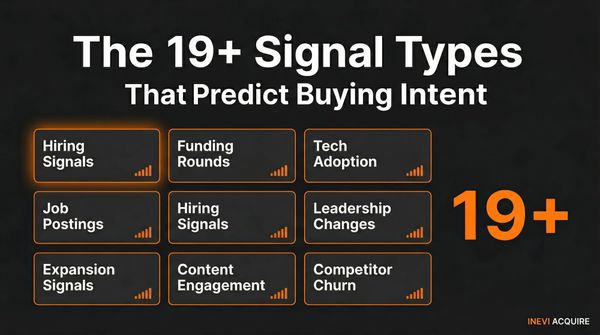
A buying signal is any observable event that indicates a company's likelihood to purchase has increased. Not all signals are equal — some predict buying intent far more reliably than others.
Tier 1: High-Intent Signals
These signals indicate active buying behavior or budget allocation. When a company shows a Tier 1 signal, they're already looking for a solution.
Relevant job postings. A company posting a job for an "AI Implementation Specialist" in their sales department has already decided they need AI in their sales process. They have budget. They're actively looking. The gap between wanting AI implementation and having it working is exactly where a managed system fits.
We monitor 225,000+ job postings daily with full description text — not just title-based filters. Title-based filters miss 60% of real hiring signals because the relevant intent is buried in the job description, not the title. A "Sales Operations Manager" posting that mentions "evaluate and implement AI outbound tools" is a stronger signal than a posting titled "AI Engineer" that's actually about computer vision.
Technology adoption. When a company adds a new tool to their stack — especially a CRM, a sales engagement platform, or a marketing automation tool — it signals they're investing in growth infrastructure. A company that just adopted HubSpot is a very different prospect than one that's been on Salesforce for five years.
Funding rounds. A company that just raised a Series A or B has capital to deploy. More specifically, they have board pressure to deploy it on growth. Post-funding companies are 3-4x more likely to invest in outbound infrastructure within 90 days of closing a round.
Tier 2: Medium-Intent Signals
These signals indicate the conditions for buying are forming, even if the company hasn't started actively looking yet.
Headcount growth. Companies growing their sales or marketing teams are investing in revenue generation. A company that hired 5 salespeople in the last quarter needs pipeline to feed them.
Executive changes. A new VP of Sales or CRO typically brings a 90-day mandate to show results. They're actively looking for quick wins in pipeline generation — and they're more open to new vendors than someone who's been in the role for three years.
Competitor adoption. When a company's direct competitors adopt a new outbound approach or tool, competitive pressure creates urgency. "Your competitor is already doing this" is one of the strongest motivators in B2B.
Tier 3: Contextual Signals
These signals don't indicate buying intent on their own, but combined with Tier 1 or 2 signals, they significantly increase conversion probability.
Industry events. Regulatory changes, market shifts, or industry-specific events that create new problems or opportunities. A new data privacy regulation might drive demand for compliant outbound tools.
Content engagement. A prospect downloading a whitepaper, attending a webinar, or engaging with specific LinkedIn content shows topic interest. This is where traditional "intent data" from platforms like Bombora or 6sense operates — but it works best when combined with behavioral signals, not in isolation.
Financial signals. Earnings reports showing declining revenue, public statements about growth priorities, or analyst downgrades can indicate companies that need to invest in pipeline generation.
How Signal Detection Actually Works
Building a signal detection system is not as simple as subscribing to a data feed. Here's the architecture at a high level — not the specific tools (we don't name our data providers externally), but the approach.
Layer 1: Signal Ingestion
The system monitors multiple data sources simultaneously. Job boards, funding databases, technology tracking platforms, news feeds, and social signals. Each source has different latency (how quickly data appears after the real-world event), accuracy (how often the data is correct), and coverage (what percentage of events it catches).
No single source catches everything. We cross-reference across 6+ providers to build a complete picture.
Layer 2: Signal Qualification
Raw signals are noisy. A company posting a job for a "Sales Manager" might be replacing a departure, not expanding. A funding round might be a bridge round to avoid shutting down, not growth capital.
The qualification layer filters raw signals through ICP criteria and contextual rules. Does this company match the target segment? Is this signal type relevant to what we're selling? Does the combination of signals suggest real buying intent, or is it noise?
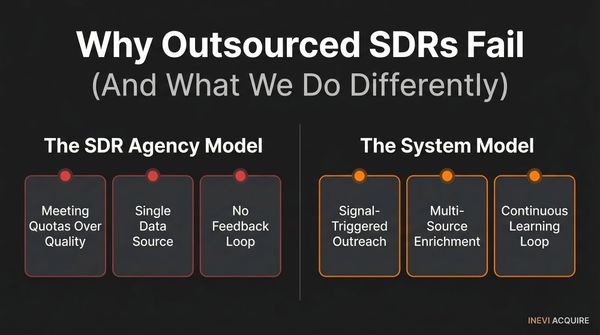
This is where most DIY implementations fail. The tools that detect signals are separate from the tools that qualify them, and connecting the two requires logic that doesn't come out of the box.
Layer 3: Enrichment
Once a company passes signal qualification, the system enriches the record. Who are the decision-makers? What are their verified email addresses? What's the company's tech stack? How many employees? What's their growth trajectory?
Enrichment comes from multiple sources because no single provider has complete data. We verify every email address through at least two independent verification methods before it enters a sending sequence. This is why our bounce rate stays under 2% — verification happens before sending, not after.
Layer 4: Sequencing
The outreach itself is triggered by the signal. The first line of every email references why we're reaching out today — what signal surfaced this company. This isn't personalization for the sake of personalization. It's relevance. The signal is the reason the email exists.
Sequences adapt based on the signal type and the persona. A CEO who just posted a job for an AI sales engineer gets a different message than a VP of Sales whose company just raised a Series B. Same product, different entry point.
Layer 5: Feedback Loop
The system learns from every response. Which signal types produce the highest reply rates? Which sequences convert best for which personas? Which data sources have the most accurate contact information?
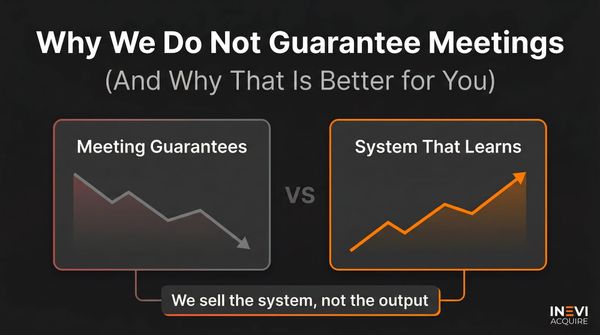
This feedback loop is what separates a system from a campaign. A campaign runs, reports, and ends. A system runs, learns, and improves. After 90 days, a signal-based system is significantly better than it was on day one — the opposite of the agency model, where results typically degrade after the first quarter.
Why Signal-Based Outbound Outperforms
The performance difference comes down to three factors:
Timing. Reaching a company when something just happened is fundamentally different from reaching them on a random Tuesday. The signal creates context. The email doesn't need to manufacture relevance — it already has it.
Quality over volume. List-based outbound compensates for poor targeting with high volume. Signal-based outbound sends fewer emails to better-qualified companies at the right moment. Lower volume, higher conversion.
Compounding improvement. Every response teaches the system which signals predict buying intent most reliably. Over months, the signal detection gets sharper, the qualification gets tighter, and the conversion rates climb. List-based outbound doesn't compound — each month starts fresh with a new list.
What It Takes to Build Signal-Based Outbound
Building a signal-based outbound system requires three things most companies underestimate:
1. Multiple tools, connected. You need signal detection, data enrichment, email verification, sequencing, deliverability management, and workflow orchestration. That's 6-8 tools minimum. Each one does its job — the hard part is making them work together reliably.
2. An operator who understands the stack. The emerging role of "GTM engineer" exists because this work requires both strategic thinking (what signals matter?) and technical skill (how do I connect Clay to my enrichment layer to my sequencer without breaking?). This person costs $120,000-150,000/year and takes 3-6 months to ramp.
3. Time to optimize. A signal-based system doesn't produce great results on day one. It takes 60-90 days of data to understand which signals predict buying intent for your specific market, which sequences convert for your specific personas, and which data sources provide the most accurate contact information for your specific ICP.
The alternative to building it yourself: plug into a system that's already built, already optimized, and already running. The trial and error is done. The tools are connected. The operator is included.
Signal-Based Outbound vs Intent Data Platforms
You might be wondering how signal-based outbound differs from intent data platforms like 6sense, Bombora, or ZoomInfo Intent.
Intent data platforms measure topic interest — they track which companies are consuming content related to specific topics. "Company X is researching CRM software" is an intent signal from these platforms.
Signal-based outbound tracks behavioral events, not just content consumption. A company posting a job listing, raising funding, or adopting new technology is doing something observable in the real world — not just reading blog posts about it.
| Intent Data Platforms | Signal-Based Outbound | |
|---|---|---|
| What it detects | Topic research behavior | Real-world business events |
| Data source | Content consumption tracking (cookies, IP) | Job boards, funding databases, tech trackers, news |
| Signal strength | Medium (research doesn't equal buying) | High (events indicate budget and urgency) |
| Privacy concerns | High (relies on tracking) | Low (monitors public data) |
| Cost | $30,000-100,000+/year | Varies by implementation |
| Best for | Enterprise ABM programs | Mid-market outbound |
| Limitation | Noisy — research often doesn't convert | Requires multi-source data for coverage |
The strongest approach combines both: use intent data to confirm topic interest, and use behavioral signals to confirm timing and budget. But if you have to pick one, behavioral signals are more predictive of near-term buying intent.
FAQ
How is signal-based outbound different from regular cold email?
Traditional cold email sends the same sequence to a static list regardless of timing. Signal-based outbound only sends emails when a specific event — like a funding round, a relevant job posting, or a technology adoption — indicates the company may be ready to buy. Every email goes out because something just happened, not because a list said to.
What are the best buying signals for B2B outbound?
The highest-intent signals are relevant job postings (indicating budget and need), funding rounds (indicating capital to deploy), and technology adoption changes (indicating infrastructure investment). Hiring signals are often 3x more predictive of buying intent than funding signals alone, especially when the job description references the specific problem your product solves.
How many signals do you need to track?
There's no magic number, but monitoring fewer than 5 signal types leaves significant blind spots. We track 19+ distinct signal types because different signals predict intent for different buyer segments. A SaaS founder responds to different triggers than a services firm owner. Coverage across multiple signal types ensures you catch opportunities regardless of which event surfaces first.
Can I build signal-based outbound with Clay?
Clay is a powerful workflow builder that can handle parts of the signal detection and enrichment process. But Clay is one tool in a 6-8 tool stack. You still need signal sources, email verification, a sequencing platform, deliverability management, and someone to connect and maintain all of it. Clay is the integration layer — it's not the complete system.
How long does it take for signal-based outbound to produce results?
With a properly built system, you can start seeing replies within the first week of sending. Meaningful patterns emerge after 30-60 days — that's when you have enough data to know which signals predict buying intent for your specific market and which sequences convert for your personas. The system compounds from there.
Does signal-based outbound work for every industry?
Signal-based outbound works for any B2B company where the buying process involves identifiable events. It's strongest in technology, professional services, and financial services where hiring, funding, and tech adoption signals are abundant and public. It's less effective in industries where buying decisions happen behind closed doors with no observable external signals.
Want to see which signals your ideal customers are sending right now? Get a free Signal Audit — no commitment, no card required.