The 19+ Signal Types That Predict Buying Intent
We track 19+ distinct signal types across millions of companies. Here's every signal type, how to detect it, and which ones actually predict near-term buying intent.
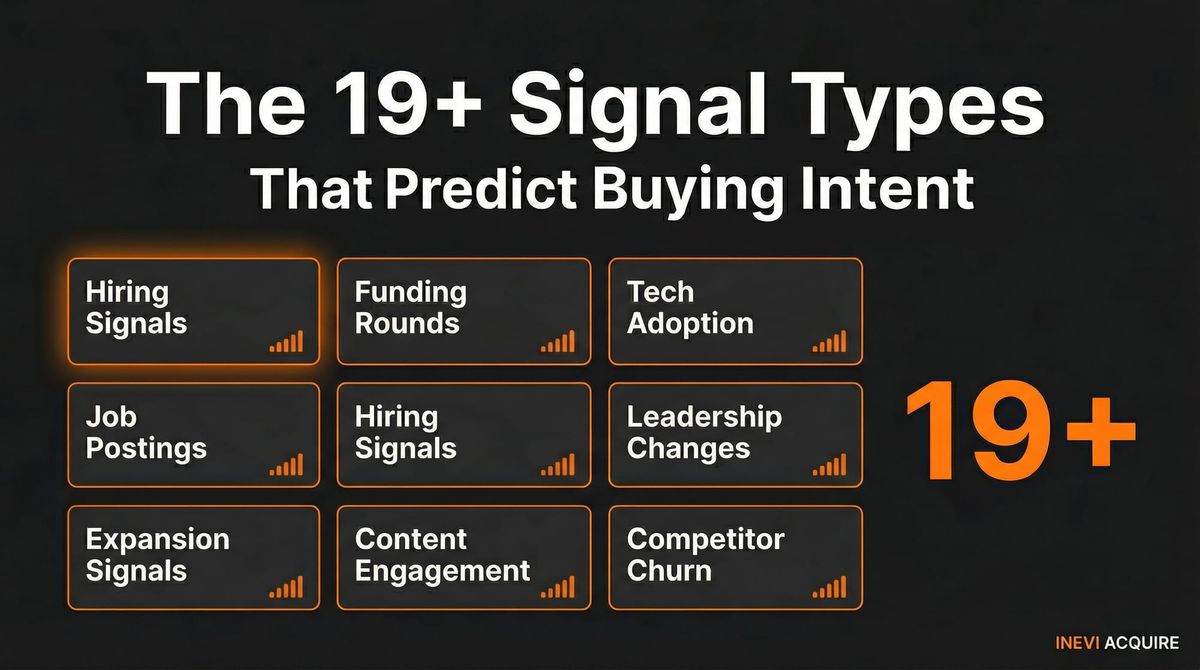
The 19+ Signal Types That Predict Buying Intent
Not all buying signals are created equal.
We track 19+ distinct signal types across our outbound system. Some predict near-term purchasing with startling accuracy. Others are barely better than noise. After six months of running all 19 simultaneously on real prospect lists, we have the data to rank them.
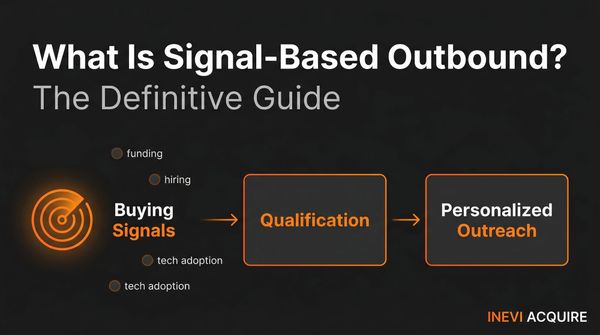
Buying signals are observable events that indicate a company's likelihood to purchase has increased. In B2B outbound, signals replace guesswork with timing. Instead of emailing a company because they match your firmographics, you email them because something just happened that makes your offering relevant right now.
This guide covers every signal type we track, how each one works, and — most importantly — which ones actually convert.
The Signal Tier Framework
We group signals into three tiers based on their predictive power for near-term buying intent. The tiers aren't theoretical — they're based on six months of conversion data across thousands of detected signals.
| Tier | Meaning | Typical Reply Rate | Typical Meeting Conversion |
|---|---|---|---|
| Tier 1: High-Intent | Company is actively looking to solve the problem | 8-15% | 2-5% |
| Tier 2: Medium-Intent | Conditions for buying are forming | 4-8% | 1-3% |
| Tier 3: Contextual | Increases conversion when combined with Tier 1-2 signals | 2-4% alone | <1% alone |
The key insight: Tier 3 signals have low standalone value but dramatically increase conversion when stacked with higher-tier signals. A company showing a Tier 1 signal + two Tier 3 signals converts at 2-3x the rate of the Tier 1 signal alone.
Tier 1: High-Intent Signals (6 Types)
These signals indicate active buying behavior or budget allocation. A company showing a Tier 1 signal has already decided they need to solve the problem — they're evaluating how.
1. Relevant Job Postings
What it detects: Company posts a job for a role that indicates they're building the capability your product provides.
Why it's strong: They've allocated budget. They've identified the need. They're actively looking. The gap between "looking for a person to solve this" and "would consider a service that solves this" is minimal.
How we detect it: Full description text analysis across 225K+ daily postings. Not title-based — description-level intent matching catches 60% more signals than title filters alone.
Signal strength: 9/10. Our highest-converting signal type. Hiring signals convert to meetings at 3x the rate of funding signals.
2. Funding Rounds
What it detects: Company raises a seed, Series A, B, C, or growth equity round.
Why it's strong: Capital to deploy, board pressure to grow, and a mandate to show results. Post-funding companies are 3-4x more likely to invest in growth infrastructure within 90 days.
How we detect it: Real-time monitoring of funding databases, press releases, and SEC filings. We cross-reference multiple sources to catch rounds that aren't publicly announced.
Signal strength: 7/10. Strong capital indicator but less specific than hiring signals about what they'll spend on. Works best when combined with other signals.
3. Technology Adoption
What it detects: Company adds or removes a specific technology from their stack (CRM, sales engagement platform, marketing automation, etc.).
Why it's strong: A company that just adopted HubSpot is building sales infrastructure. A company that just dropped Outreach is looking for an alternative. Technology changes signal active investment in the capability area.
How we detect it: Technology tracking platforms that monitor website scripts, DNS records, and API integrations. We track additions, removals, and switches.
Signal strength: 8/10. Highly specific to the capability area. A company adding a CRM for the first time is a different prospect than one migrating from one CRM to another.
4. Vendor Review Activity
What it detects: Company is actively evaluating vendors on review sites (G2, Capterra, TrustRadius) in your product category.
Why it's strong: Active comparison shopping. They've moved past "do we need this?" to "which one should we buy?"
How we detect it: G2 buyer intent data and similar review platform intent signals. Shows which companies are reading reviews and comparing products in specific categories.
Signal strength: 7/10. Very high intent, but limited to companies that use review sites for evaluation. Smaller companies and non-tech sectors may not show up here.
5. Direct Competitor Churn
What it detects: Company cancels or doesn't renew a competitor's product.
Why it's strong: They've already validated the need. They're not questioning whether they need outbound — they're questioning whether their current provider is the right one. The sale is about differentiation, not education.
How we detect it: Technology removal tracking, combined with contract renewal cycle estimation. A company that drops a competitor's tool is immediately in-market.
Signal strength: 8/10. Extremely high conversion potential, but low volume — you're limited to the competitor's churn rate.
6. Community Intent Signals
What it detects: Someone in a Slack community, Reddit thread, LinkedIn group, Discord server, or industry forum asks for a recommendation, vents about a pain point, or describes a problem your product solves. In their own words, in real time.
Why it's strong: This isn't structured data. It's a person telling you exactly what they need, in the moment they need it. A founder posting in a Slack community "has anyone found an outbound tool that actually works?" is a higher-intent signal than a funding round. They've already tried, already failed, and are actively looking for the answer.
How we detect it: Programmatic monitoring across communities, forums, and professional groups. Not keyword matching. Profile-level identification so the signal maps to a real person at a real company that enters the enrichment layer with full context on what triggered them.
Signal strength: 9/10. Comparable to hiring signals in conversion rate. The difference: community signals capture intent that never shows up in structured databases. The person asking for help in a Slack group isn't posting a job listing or filing an SEC document. Without community monitoring, this signal is invisible.
Tier 2: Medium-Intent Signals (7 Types)
These signals indicate the conditions for buying are forming, even if the company hasn't started actively looking yet.
7. Headcount Growth
What it detects: Company grows headcount by 20%+ in the last quarter, especially in sales or marketing.
Why it's strong: More salespeople need more pipeline. Companies investing in revenue headcount have an immediate need for pipeline generation infrastructure.
Signal strength: 6/10. Directional but non-specific. The company could fill pipeline through inbound, referrals, or existing channels.
8. Executive Hires
What it detects: New VP of Sales, CRO, Head of Growth, or CMO appointment.
Why it's strong: New executives come with a 90-day mandate to show results. They're more receptive to new vendors than someone who's been in the role for three years.
Signal strength: 7/10. Strong timing indicator. The window is 30-90 days from start date — after that, they've typically committed to a direction.
9. Competitor Adoption
What it detects: A company's direct competitors adopt a new outbound approach or tool.
Why it's strong: Competitive pressure creates urgency. "Your competitors are already booking meetings through signal-based outbound" is a strong motivator.
Signal strength: 5/10. Effective as a messaging angle but doesn't indicate the company's own readiness.
10. Revenue Milestone
What it detects: Company crosses a revenue threshold ($1M, $5M, $10M ARR) or reports significant growth.
Why it's strong: Growth-stage companies need to systematize pipeline generation. What worked at $1M (founder-led sales, referrals) breaks at $5M.
Signal strength: 6/10. Good ICP qualifier but imprecise timing.
11. Product Launch
What it detects: Company launches a new product or enters a new market segment.
Why it's strong: New products need pipeline. New markets need outreach. The launch creates immediate demand for targeted outbound to the new segment.
Signal strength: 6/10. Strong relevance but depends on whether the company will build outbound for the new product vs. relying on existing channels.
12. Partnership Announcement
What it detects: Company announces a strategic partnership, integration, or channel agreement.
Why it's strong: Partnerships often indicate growth mode. The company is expanding its ecosystem, which suggests investment in go-to-market infrastructure.
Signal strength: 5/10. Weak standalone signal but compounds well with hiring or funding signals.
13. Conference/Event Participation
What it detects: Company is sponsoring, speaking at, or exhibiting at industry events.
Why it's strong: Event investment indicates marketing budget and growth ambition. Companies spending $10K-50K on conference presence are investing in pipeline generation.
Signal strength: 5/10. Timing is useful (pre-event is better than post-event) but the signal is indirect.
Tier 3: Contextual Signals (7 Types)
These signals don't indicate buying intent on their own, but when combined with Tier 1 or 2 signals, they significantly increase conversion probability.
14. Content Engagement
What it detects: Prospect engages with your content — downloads a whitepaper, attends a webinar, visits specific pages multiple times.
Signal strength: 4/10 alone, 8/10 stacked. A prospect who read your blog post AND whose company just posted a relevant job listing is highly qualified.
15. Industry Regulatory Changes
What it detects: New regulations or compliance requirements in the prospect's industry that affect their go-to-market approach.
Signal strength: 4/10 alone. Creates urgency for companies in affected industries but doesn't indicate individual company readiness.
16. Market Shift Events
What it detects: Significant market changes — economic downturns, industry consolidation, supply chain disruptions — that create new problems or priorities.
Signal strength: 3/10 alone. Very broad signal. Useful for messaging context ("In a market where growth budgets are under scrutiny, predictable pipeline matters more than ever") but not for targeting.
17. Financial Performance Signals
What it detects: Earnings reports showing declining revenue, missed growth targets, or analyst downgrades.
Signal strength: 4/10 alone. Companies under growth pressure may be more receptive to pipeline solutions, but the timing and relevance are variable.
18. Social Media Activity
What it detects: Company leadership posting about challenges, asking for recommendations, or discussing relevant topics on LinkedIn/Twitter.
Signal strength: 3/10 alone. Social activity indicates awareness of the problem but not readiness to act. Better as a warm-up signal — engage with their content before reaching out.
19. Website Changes
What it detects: Company updates their website — new pricing page, new product page, new messaging focused on the capability area you sell.
Signal strength: 4/10 alone. Website changes indicate strategic shifts but the specific change matters. A company adding a "Request Demo" page for the first time is a different signal than a routine design refresh.
20. Geographic Expansion
What it detects: Company opens new offices, enters new markets, or starts hiring in new regions.
Signal strength: 4/10 alone. Geographic expansion creates outbound needs in the new market, but the company may handle this through their existing infrastructure.
How Signal Stacking Works
The real power of signal-based outbound isn't any individual signal — it's the combination.
Single signals give you timing. Stacked signals give you confidence. Here's how stacking changes conversion probability:
| Configuration | Typical Reply Rate |
|---|---|
| 1 Tier 1 signal alone | 8-15% |
| 1 Tier 1 + 1 Tier 2 | 12-18% |
| 1 Tier 1 + 2 Tier 3 | 10-16% |
| 2 Tier 1 signals | 15-22% |
| 1 Tier 1 + 1 Tier 2 + 1 Tier 3 | 14-20% |
The practical implication: you need multiple signal sources running simultaneously. A system that only tracks funding rounds is leaving most of its potential on the table. A system that tracks funding + hiring + tech adoption + vendor reviews captures signals that any individual source misses.
What This Means for Your Outbound
If you're building or evaluating outbound, the signal landscape is the variable that matters most. Here are the takeaways:
Start with Tier 1 signals. Hiring, funding, and technology adoption are the three highest-converting signal types. If you're only tracking one, start with hiring signals.
Don't track signals you can't act on. A signal is only useful if you can reach the right person at the right company with the right message within 14 days of detection. If your system can detect a signal but takes three weeks to enrich and sequence, the timing advantage is gone.
Invest in stacking, not volume. Five signal types detected with high accuracy beats 20 signal types detected with poor accuracy. Quality of detection matters more than quantity of signal types.
Measure by signal type, not in aggregate. Tracking "average reply rate across all outbound" tells you nothing useful. Track reply rate by signal type, by tier, and by stack combination. This data tells you where to invest and what to drop.
Our system tracks all 19+ types, but the top 6 drive 80% of qualified meetings. The rest provide stacking value that increases conversion on high-intent signals.
FAQ
What is the best buying signal for B2B sales?
Hiring signals are the highest-converting individual signal type, outperforming funding rounds by roughly 3x in meeting conversion rate. A company posting a job for the capability your product provides has already allocated budget and identified the need. The gap between "looking for a hire" and "would consider a service" is minimal.
How many signal types should I track?
At minimum, track 3-5 Tier 1 and Tier 2 signal types. Our system tracks 19+, but the top 6 drive 80% of qualified meetings. Start with hiring signals, funding rounds, community intent, and technology adoption changes. Add vendor review activity and competitor churn as you scale. Tier 3 signals add stacking value but have limited standalone utility.
What is signal stacking?
Signal stacking means detecting multiple signals from the same company and using the combination to prioritize outreach and tailor messaging. A company that raised a Series B (funding signal), posted a job for a Sales Ops Manager (hiring signal), and just adopted HubSpot (tech adoption signal) is showing three independent indicators of growth investment. Stacked signals convert at 2-3x the rate of individual signals.
Are intent data platforms the same as signal detection?
No. Intent data platforms (6sense, Bombora) primarily measure content consumption patterns — which companies are researching topics online. Signal detection tracks observable business events like hiring, funding, and technology changes. Behavioral signals are more predictive of near-term purchasing because they indicate action and budget allocation, not just interest. The strongest approach combines both.
How quickly should I act on a buying signal?
The optimal window for most Tier 1 signals is 2-14 days after detection. For hiring signals specifically, the window is 2-21 days (before the company commits to a hire). For funding signals, 30-60 days post-announcement. For technology adoption changes, 7-30 days. After these windows, the company has likely committed to a direction and is less receptive to alternatives.
Want to see which of the 19+ signal types your ideal customers are triggering right now? Including community signals most tools miss entirely? Get a free Signal Audit — no commitment, no card required.