The Real Cost of Building Outbound In-House (6-8 Tools Breakdown)
Building outbound in-house requires 6-8 tools, a GTM engineer, and 3-6 months of optimization. Here's the real cost breakdown most companies don't do before signing up.
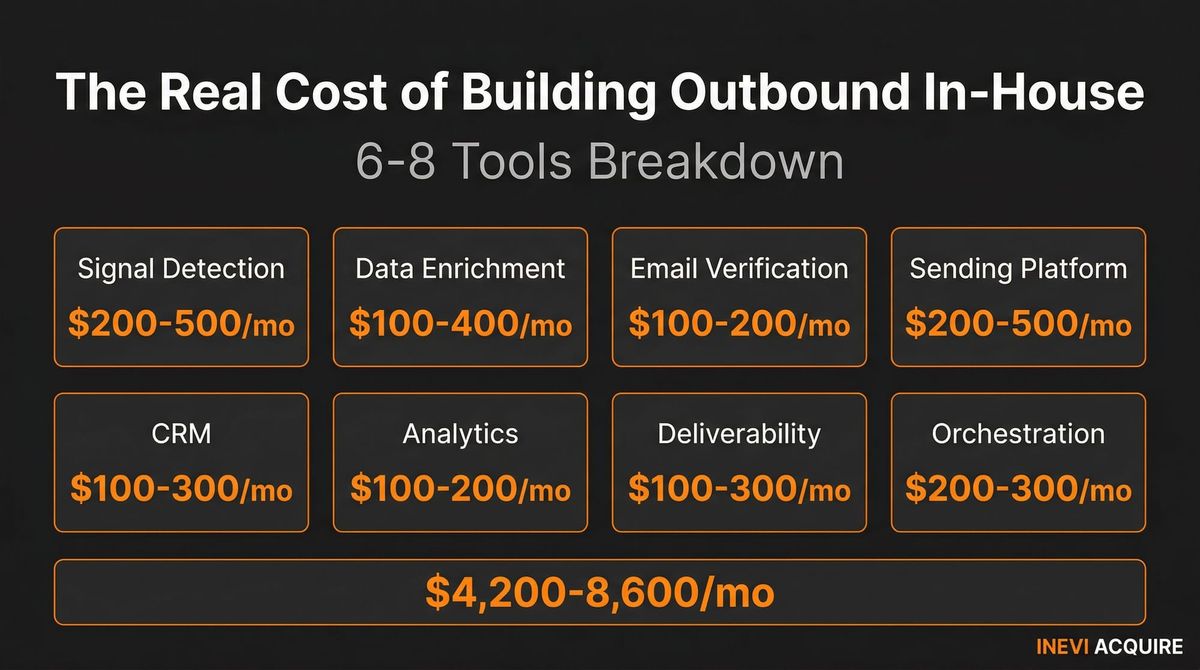
The Real Cost of Building Outbound In-House (6-8 Tools Breakdown)
Every founder I talk to has the same story. They watched a Clay tutorial on YouTube. They signed up for Apollo. They tried Instantly for sending. They spent a weekend trying to connect them. Then Monday came and they went back to doing the work they're actually good at.
The outbound tool landscape has exploded since 2023. There are genuine options for every part of the process. The challenge isn't finding tools. It's connecting 6-8 of them into a system that works reliably, every day, without someone babysitting it.
Here's the cost breakdown nobody does before signing up for their third free trial.
The 6-8 Tools You Actually Need
Building a complete outbound system from scratch requires coverage across six distinct functions. Some tools cover two functions. None cover all six. Here's what you need and what each layer costs.
The total cost of building a modern outbound system in-house includes 6-8 software tools at $1,200-16,000 per month, a GTM engineer at $120,000-150,000 per year, and 3-6 months of optimization time before the system produces consistent results. First-year all-in cost: $180,000-330,000.
1. Signal Detection — $200-1,500/month
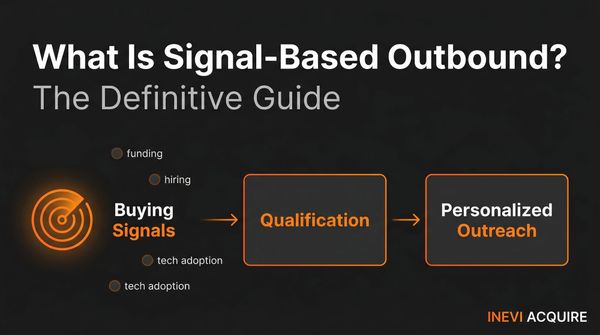
This is where you identify which companies to target and when. The old way was buying a static list filtered by firmographics. The new way is monitoring real-time events: funding rounds, job postings, technology changes, executive moves.
Common tools: Clay (workflow builder with signal integrations), Trigify, Ocean.io, BuiltWith (for tech adoption signals)
The catch: No single signal source catches every event type. You need multiple inputs to cover funding signals, hiring signals, and technology signals. Clay can orchestrate some of this, but it needs the data sources plugged into it — and choosing which sources to use is the first decision that takes weeks of evaluation.
2. Data Enrichment — $300-2,000/month
Once you've identified a target company, you need the decision-maker contacts. Name, title, email, phone, company details. Enrichment tools fill in these gaps.
Common tools: Apollo, Clearbit (now Breeze), Lusha, RocketReach, Hunter, PeopleDataLabs
The catch: Every enrichment provider has coverage gaps. Apollo might have 70% of your target contacts. Clearbit covers different segments. The only way to get 90%+ coverage is to cross-reference multiple providers — which means paying for multiple tools and building logic to merge and deduplicate the results.
We tested every major enrichment provider head-to-head on the same list of 500 target companies. No single provider returned valid contact data for more than 74% of them. By cross-referencing three providers, we got to 91%.
3. Email Verification — $50-300/month
Every unverified email you send risks your sender reputation. A bounce rate above 3% triggers spam filters and can burn an entire sending domain. Verification checks whether an email address actually exists and can receive mail before you send.
Common tools: ZeroBounce, NeverBounce, MillionVerifier, EmailListVerify
The catch: Verification isn't a one-time check. Email addresses go stale — people change jobs, companies restructure, domains expire. An email that was valid three months ago might bounce today. Your verification step needs to run right before sending, not when the list was originally built.
We verify every email through two independent methods. The result: bounce rates consistently under 2%. For context, the industry average for B2B cold email is 4-6%.
4. Sequencing — $100-500/month
The tool that actually sends the emails. Manages the sequence (email 1, wait 3 days, email 2, wait 5 days, email 3), handles replies, and tracks opens and clicks.
Common tools: Instantly, Smartlead, Lemlist, Woodpecker, Mailshake
The catch: Sequencing tools all look similar on the surface. The differences matter at scale: how many sending accounts can you rotate? How does it handle reply detection? Can it pause a sequence if deliverability drops? Can it branch sequences based on engagement? The features that matter most are the features you don't realize you need until month two.
5. Deliverability Management — $100-400/month
Keeping your emails out of spam. This includes domain warming, sender reputation monitoring, and inbox placement testing. Deliverability is the silent killer of outbound — you can build the perfect system, but if emails land in spam, nothing happens.
Common tools: Warmbox, Instantly (has warming built in), Folderly, InboxAlly, GlockApps (for testing)
The catch: Domain warming takes 14-21 days before you can send at meaningful volume. Most companies skip this or rush it, then wonder why reply rates are near zero. A properly warmed domain with managed sending limits is the difference between 95%+ inbox placement and landing in spam.
6. Workflow Orchestration — $0-500/month
Something needs to connect all of this. When a signal fires, the workflow engine should trigger enrichment, run verification, route to the right sequence, and log the activity. This is where Clay lives — but it's also where most DIY builds break.
Common tools: Clay, n8n, Make (Zapier is too limited for outbound workflows), custom scripts
The catch: This is the hardest layer to get right. The orchestration layer handles edge cases: what happens when enrichment returns incomplete data? When verification fails? When a contact already exists in a different sequence? When two signals fire for the same company? Every edge case that goes unhandled is a contact that either gets missed or gets a bad experience.
The Tool Stack Cost Summary
| Layer | Tool Examples | Monthly Cost |
|---|---|---|
| Signal Detection | Clay, Trigify, BuiltWith | $200-1,500 |
| Data Enrichment | Apollo, Clearbit, Lusha | $300-2,000 |
| Email Verification | ZeroBounce, NeverBounce | $50-300 |
| Sequencing | Instantly, Smartlead, Lemlist | $100-500 |
| Deliverability | Warmbox, Folderly, GlockApps | $100-400 |
| Workflow Orchestration | Clay, n8n, Make | $0-500 |
| Total Software | $750-5,200/month |
But $750-5,200/month is the optimistic number — that's one tool per layer. In practice, you need 2-3 enrichment sources for coverage and multiple tools with overlapping features. Realistic software cost: $1,200-8,000/month ($14,400-96,000/year).
The Cost Nobody Talks About: The Operator
Software without an operator is shelf-ware.
Someone needs to evaluate which tools to use. Configure them. Connect them. Build the workflows. Monitor deliverability. Write the sequences. Analyze the results. Fix the edge cases. Optimize based on data.
This is a full-time job. It's called a GTM engineer — a role that barely existed two years ago. It combines revenue operations expertise (understanding the sales funnel, ICP targeting, conversion metrics) with technical skills (API integrations, workflow logic, data manipulation).
What a GTM Engineer Costs
| Component | Annual Cost |
|---|---|
| Base salary | $120,000-150,000 |
| Benefits (20-30% load) | $24,000-45,000 |
| Recruiting cost (15-20% of salary) | $18,000-30,000 |
| Ramp time (3-6 months at reduced output) | $30,000-75,000 in delayed value |
| Total first-year cost | $192,000-300,000 |
And that assumes you can find one. The GTM engineer talent pool is tiny. The role requires a rare combination of strategic thinking and technical execution. Most companies post the role for 2-3 months before making a hire — if they make one at all.
I keep seeing LinkedIn posts from founders who've had the "GTM engineer" role open for 12 weeks with zero qualified applicants. The skillset exists in maybe a few thousand people globally. The demand is 10x the supply.
What Happens Without the Operator
Here's what happens when companies try to build outbound without a dedicated operator:
Week 1-2: Sign up for 3-4 tools. Watch tutorials. Feel productive.
Week 3-4: Realize the tools don't connect automatically. Spend hours in Clay trying to build a workflow. Hit an API limit. Work around it. Hit another edge case.
Month 2: The founder who was building this goes back to their actual job. The half-built system sits idle. Emails stop going out. Nobody notices for two weeks.
Month 3: Someone asks "whatever happened to our outbound?" The founder spends a weekend re-learning the tools. Rebuilds part of the workflow. Sends a batch. Gets 2 replies. Can't tell if the system is working or not.
Month 4-6: The company is back where it started. They've spent $5,000-15,000 in software, 100+ hours of founder time, and have nothing systematic to show for it.
This pattern is so common it has a name: the complexity wall. The tools are individually powerful. Connecting them into a reliable system is the part that breaks people.
The Full Cost Comparison
| Cost Component | DIY (Year 1) | GTM Engineer Hire (Year 1) | Managed System (Year 1) |
|---|---|---|---|
| Software tools | $14,400-96,000 | $14,400-96,000 | Included |
| Personnel | $0 (founder time) | $192,000-300,000 | Included |
| Founder time (opportunity cost) | 500+ hours | 50-100 hours (management) | ~10 hours (onboarding) |
| Time to first results | 3-6 months | 3-6 months | 2-3 weeks |
| Total cash cost | $14,400-96,000 | $206,000-396,000 | $42,000-180,000 |
| Total real cost (incl. time) | $100,000+ | $206,000-396,000 | $42,000-180,000 |
The DIY path looks cheapest on paper. But factor in the opportunity cost of 500+ founder hours — time not spent on product, sales, or hiring — and the math changes. At a conservative $200/hour founder value, that's $100,000 in opportunity cost on top of the software.
The Question to Ask Yourself
The question isn't "which tools should we use?" It's "what's the real cost of figuring this out ourselves, and is that the best use of our next 6 months?"
For some companies, the answer is yes. If you're hiring a GTM engineer anyway and plan to run outbound as a core competency, building in-house makes sense. You'll invest more upfront but own the entire system long-term.
For most companies — especially growth-stage startups and services firms without dedicated sales operations — the math favors plugging into a system that's already built. You skip the tool evaluation, the integration headaches, the 3-6 month optimization period, and the $120K+ hire. You're live in two weeks.
The trial and error is real. We've been through it. You don't have to.
FAQ
How many tools do I need for outbound in 2026?
A complete signal-based outbound system requires 6-8 tools across six layers: signal detection, data enrichment, email verification, sequencing, deliverability management, and workflow orchestration. Some tools cover multiple layers, but no single tool covers all six. Realistic monthly software cost: $1,200-8,000.
Can I build outbound with just Clay?
Clay is a powerful orchestration layer, but it's not the complete system. Clay connects tools and builds workflows, but you still need signal sources, enrichment providers, a sequencing platform, deliverability management, and verification tools plugged into it. Clay is the integration layer — one tool in a 6-8 tool stack.
What is a GTM engineer and how much do they cost?
A GTM engineer combines revenue operations expertise with technical tool stack engineering. They evaluate, connect, and optimize the tools needed for modern outbound. Salary range: $120,000-150,000 base, with total first-year cost (benefits, recruiting, ramp time) reaching $192,000-300,000. The role is new enough that qualified candidates are scarce.
How long does it take to build outbound in-house?
Expect 3-6 months from first tool signup to a system that produces consistent results. The first month is tool evaluation and setup. The second month is integration and workflow building. Months 3-6 are optimization — learning which signals, sequences, and data sources work for your specific market.
Why do most DIY outbound projects fail?
They fail at the connection layer, not the tool layer. Individual tools work fine. Making 6-8 tools exchange data reliably, handle edge cases, and maintain deliverability requires dedicated operational expertise that most teams don't have. The complexity wall hits around week 3-4, which is when most founders abandon the project to focus on their actual job.
What's the alternative to building in-house?
Three options: hire an agency (campaign-based, results often degrade after 90 days), hire a GTM engineer (expensive, long ramp, hard to find), or plug into a managed system (pre-built infrastructure operated by specialists, live in 2 weeks). The right choice depends on your budget, team, and timeline.
Want to see what a fully connected outbound system looks like for your ICP? Get a free Signal Audit — no commitment, no card required.